

Awareness Is Learned: Shifting a Distracted Culture Toward Connection and Responsibility
Our culture teaches distraction, not awareness. Learn how Paratus is helping people retrain their minds to live alert, connected, and prepared for anything.
Walk through any public space today, a grocery store, a park, a train station, even a church, and what do you see?
Heads down. Eyes fixed on screens. Earbuds in. Everyone is in their own little world.
We’ve built a culture that’s more connected online than ever, yet more disconnected in reality than at any point in history.
And the truth is, it’s costing us.
Every day, stories surface of tragedies that might have been prevented if someone had noticed something, spoken up, or paid attention. But our society doesn’t teach awareness anymore; instead, it teaches distraction. It rewards consumption, convenience, and comfort.
It’s time to change that.
Awareness Isn’t Instinct: It’s a Skill
Awareness isn’t something we’re born with; it’s something we develop. Like any skill, it must be learned, practiced, and sharpened over time.
We’re not talking about fear or paranoia. We’re talking about purposeful living.
Learning to pay attention to the world around you.
Learning to read body language, trust your instincts, and recognize when something doesn’t feel right.
At Paratus, we teach that awareness is a daily discipline; one that shapes not only your safety but your relationships, your confidence, and your ability to protect others. It’s the difference between reacting and responding.
We’ve Been Trained to Be Distracted
Think about it…
From the moment we wake up, we’re surrounded by noise. Notifications. Headlines. Ads. Endless scrolling.
We’ve trained our brains to live on autopilot.
The problem is that autopilot leaves us vulnerable to accidents and threats, and leaves us missing the moments that matter most. Distraction has become our default setting. At Paratus, we believe that awareness must become our reset.
Retraining your focus is not easy, but it’s possible. And more than that, it’s essential.
Awareness as an Act of Love
Awareness isn’t only about protecting yourself, it’s about caring for others.
When you’re alert and engaged, you notice the small things: the child who wanders too far, the person struggling to find help, the situation that feels off before it escalates.
That’s compassion in action.
It’s living out one of the most powerful biblical truths:
“As iron sharpens iron, so one person sharpens another.” — Proverbs 27:17
When one person practices awareness, it sharpens the awareness of those around them. It spreads.
Awareness strengthens families, workplaces, churches, and communities.
Changing the Culture Together
At Paratus, we believe awareness isn’t just a skill; it’s a calling. We’re working to shift our culture away from isolation and distraction toward one of connection, responsibility, and courage.
Our mission is simple:
Prepare for the unexpected through awareness training.
Prevent tragedy through early recognition and action.
Protect yourself, your loved ones, and your community.
This is how we take back responsibility… not by waiting for someone else to fix it, but by choosing to see, to care, and to act. Because when awareness becomes our habit, safety becomes our culture.
The Challenge for All of Us
So here’s the challenge:
Next time you walk through a parking lot, step into a store, or scroll through your phone in public:
Stop for a second.
Look up.
Scan your surroundings.
Notice the people near you.
Each time you do, you’re retraining your brain to live with awareness and helping change the culture around you.
Let’s build a world where awareness is learned, practiced, and shared one person, one family, and one community at a time.
Learn more about how Paratus is reshaping culture through awareness: https://www.paratus.group
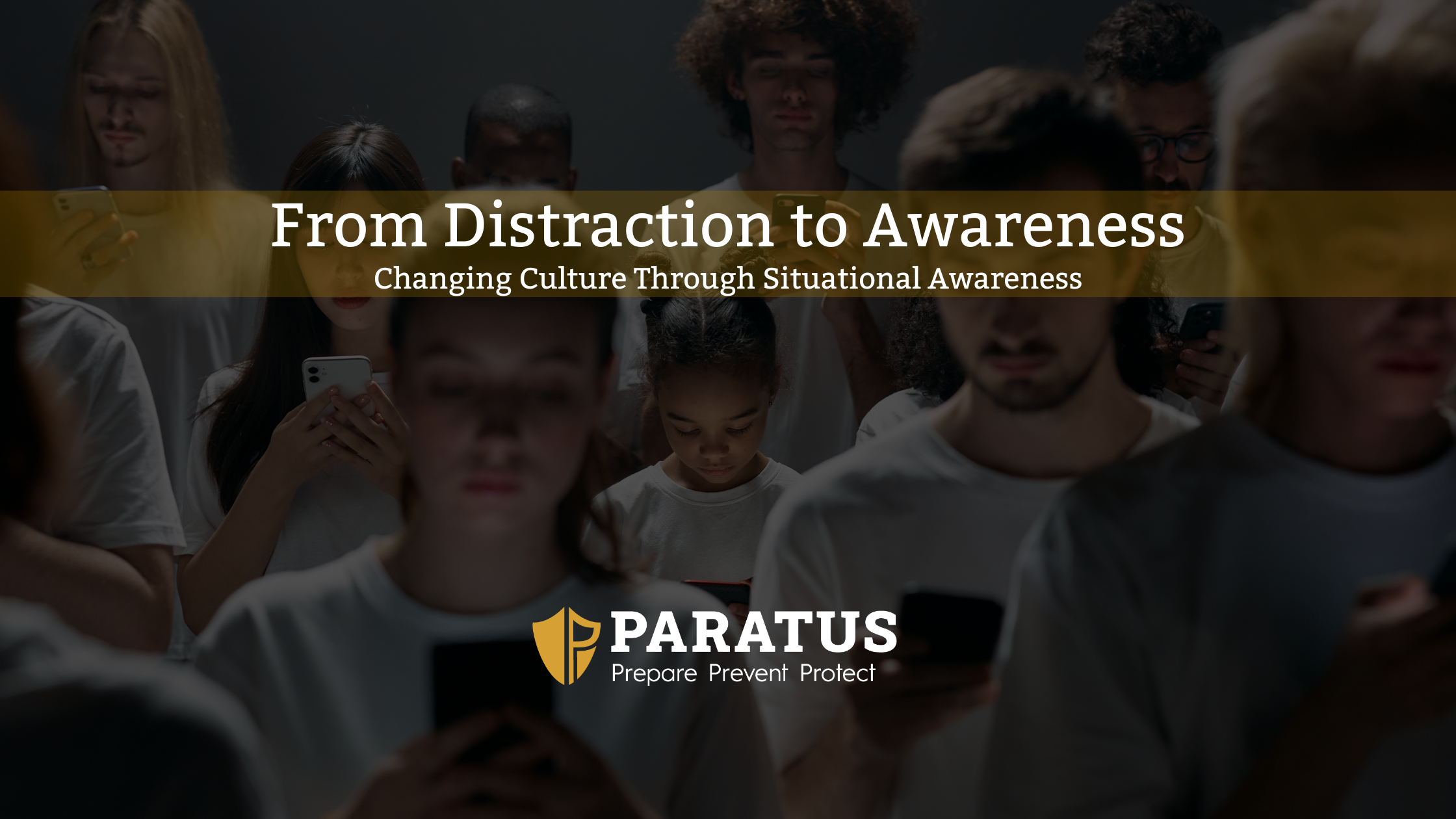
From Distraction to awareness
Our culture is distracted and disconnected. Learn how situational awareness training can shift society from isolation to responsibility and safety.
Walk into almost any public space today - an airport, a coffee shop, a train car, a restaurant, or a grocery store, and you’ll see the same picture: heads down, eyes glued to phones, earbuds in, people moving through life in their own little bubble.
On the surface, this looks harmless.
But beneath it lies a dangerous cultural shift: a society that is disconnected, distracted, and unprepared to protect itself or one another.
The Truth About Our Current Culture
We live in a time when danger doesn’t always announce itself loudly. Threats often begin quietly, in body language, in conversations, in online posts. But too often, we miss them because we aren’t paying attention.
This isn’t just about individual safety. It’s about the erosion of collective responsibility. When everyone keeps to themselves, when people convince themselves “someone else will act,” tragedies escalate. This is the bystander effect playing out in real time, over and over again.
What Needs to Change
We can’t fix cultural distraction with another policy, committee, or task force. Those approaches are reactive, top-down, and slow. What we need is a cultural shift - one that starts with people taking back responsibility in their daily lives.
Imagine a culture where:
Parents teach their kids not just to be careful, but also how to notice warning signs.
Commuters on a subway car look up, notice distress, and take action before it’s too late.
Neighbors check in on one another, not just after tragedy, but before.
That’s the kind of world Paratus is working to build.
The Paratus Approach
At Paratus, we believe the solution is simple, but powerful: train people to be more aware, more in tune, and more confident to act.
Through our 3P Process—Prepare, Prevent, Protect—we equip families, schools, businesses, and communities with skills that build habits, not just knowledge. Our programs are designed to:
✔ Develop daily situational awareness skills
✔ Teach the 10 Critical Skills of safety and responsibility
✔ Empower people to act as their own first responder when it matters most
✔ Shift from isolated, reactive thinking toa connected, proactive culture
This is not about paranoia. It’s about empowerment. It’s about love for our families, communities, and one another.
Our Hope for the Future
We know the cultural climate won’t change overnight. But every time a parent practices awareness with their child, every time an employee notices a risk at work, every time a community member decides not to look away - we move one step closer to a safer world.
This is the mission of Paratus: to break free from distraction and isolation, and to replace them with awareness, responsibility, and courage.
Because the truth is, culture doesn’t just happen. We create it.
And together, we can create one where everyone is safer, stronger, and more connected.
Ready to Take Back Responsibility?
Learn how the Paratus program can empower you, your family, or your organization: www.paratus.group/takebackresponsibility
The Myth of “Safe Places”: Why awareness matters everywhere
From schools to subways, recent tragedies show no place is guaranteed safe. Learn why situational awareness is the daily habit that protects us all.
When you think of a “safe place,” what comes to mind?
Maybe it’s your child’s school. Your neighborhood grocery store. Your favorite gym. A church pew.
These are spaces where we feel comfortable…where routine and familiarity trick us into believing danger can’t touch us.
But the truth is this: there are no guarantees.
The Problem With “It Won’t Happen Here”
Tragedy often strikes in the places we least expect it: a Catholic school in Minneapolis, a park in Stamford, a nightclub in Brooklyn, a subway train in Charlotte.
These places were filled with ordinary people going about their lives. And yet, danger walked in.
When we buy into the myth of “safe places,” we let our guard down. We get distracted. We stop noticing who’s around us or what’s happening nearby. That false sense of security makes us more vulnerable…not less.
Everyday Spaces, Everyday Risks
Most people don’t expect violence or emergencies in everyday spaces. But consider:
Schools & Campuses: Since 2018, the U.S. has averaged at least one school shooting per week.
Workplaces: Nearly 2 million Americans experience workplace violence every year.
Public Transit: Whether theft, harassment, or assaults, transit systems see incidents daily across major cities.
Neighborhoods: Carjackings, burglaries, and even opportunistic crimes happen where people feel “most comfortable.”
The lesson? Location alone doesn’t make you safe. Habits do.
Awareness as a Daily Practice
Situational awareness doesn’t mean living in fear. It means living prepared.
Here are three ways to carry awareness into every space:
1️⃣ Notice people, not just places. Look at body language, not just scenery.
2️⃣ Limit distractions. Eyes up, phone down, especially in transitional spaces like parking lots.
3️⃣ Know your options. In every room or setting, identify exits or safe routes.
These small habits, practiced daily, stack into confidence. Instead of worrying “what if,” you already know what to do.
Collective Responsibility in “Safe Places”
Awareness is contagious. When one person looks up, pays attention, and takes responsibility, it signals to others to do the same.
Parents model awareness to kids, teachers create cultures of safety in classrooms, employees watch out for coworkers, and communities where people care enough to notice and act.
That’s how “safe places” become safer: not by assuming security, but by sharing responsibility.
The Paratus Mission
At Paratus, we challenge the myth of safe places because we know safety is not a guarantee—it’s a mindset.
Our Take Back Responsibility program equips families, schools, businesses, and communities with the skills to:
Prepare for the unexpected,
Prevent risks from escalating,
Protect themselves and those around them.
Because safety doesn’t live in buildings, policies, or routines, it lives in people who are ready, aware, and willing to take responsibility.
Don’t settle for the myth of safe places. Build the habits that make safety real.
Learn more and join the mission: https://www.paratus.group/takebackresponsibility
Collective Responsibility: Why Awareness Is Everyone’s Job
Most tragedies show warning signs before they happen. Learn how collective responsibility and situational awareness can protect families and communities.
When tragedy strikes…whether it’s a school shooting, a workplace attack, or violence in a public space, we almost always hear the same heartbreaking question:
“Why didn’t anyone see this coming?”
The painful truth is, in most cases, there were signs.
The recent Minneapolis Catholic school shooting is one more devastating reminder. Before opening fire, the attacker posted online about his intentions. Again and again, across different tragedies, we’ve seen the same pattern: warning signs show up in conversations, troubling behaviors, or digital footprints.
And too often, those signs are ignored, dismissed, or left for “someone else” to handle.
Why Collective Responsibility Matters
Safety is not just the job of law enforcement or school administrators. It belongs to all of us.
Parents who notice sudden changes in their child’s behavior.
Friends who hear concerning statements.
Coworkers who see unusual or alarming actions.
Community members who sense something is “off.”
Every person has the potential to recognize danger before it escalates. But recognition alone is not enough—we also need the confidence and skills to act.
That’s what collective responsibility is: a shared commitment to notice, to speak up, and to step in before it’s too late.
The Role of Situational Awareness
Situational awareness isn’t just about what you do in the middle of an emergency. It’s about the habits you practice every day that make you capable of preventing one.
With training, people can learn to:
✔ Spot small changes in behavior or environment
✔ Trust instincts when something feels wrong
✔ Decide when to intervene, speak up, or seek help
When awareness is practiced at every level - families, schools, workplaces, and communities - it creates a safety net. Everyone contributes, and the burden doesn’t fall on just a few.
Turning Awareness Into Action
Collective responsibility becomes real when it is put into practice:
Families can prepare their kids with awareness habits so they’re not blindsided when they’re out of sight.
Businesses can train employees to notice early risks, protecting both people and operations.
Schools can integrate awareness into daily culture so that students and staff alike understand the signs and know what to do.
When people act together, prevention becomes possible. And prevention means fewer headlines, fewer vigils, and fewer families grieving loved ones who should still be here.
The Paratus Mission
This is why Paratus exists.
Our Take Back Responsibility program equips individuals, families, schools, and businesses with the mindsets and tools to make awareness a daily habit.
Because when we share responsibility, we share safety.
And when we practice awareness, we prevent tragedy.
Don’t wait until it’s too late.
Join us in building a culture of collective responsibility.
Accountability or Overreach? Why Holding Kids Directly Responsible Matters More Than Punishing Parents
In Gloucester Township, NJ, a new law fines or jails parents for their child’s repeated offenses. While intended to curb youth misbehavior, it raises questions of fairness and effectiveness. This blog explores why holding kids directly accountable builds responsibility, protects families, and better aligns with the Paratus mission: helping people Prepare, Prevent, Protect.
On July 28, 2025, Gloucester Township, New Jersey, passed a new ordinance that has sparked nationwide debate. The “Minors and Parent Responsibility Ordinance” allows parents to be fined up to $2,000 or even jailed for up to 90 days if their child is repeatedly found guilty of certain offenses in juvenile court. These range from loitering and truancy to assault and drug-related activity.
The ordinance followed a massive disturbance in June 2024 during the Gloucester Township Day and Drone Show. Nearly 500 minors caused chaos, leading to injuries for three police officers and multiple juvenile arrests. Local leaders said enough was enough, and parents must be held accountable.
But is punishing parents the right solution? Or does it ignore the deeper issue of youth accountability and responsibility?
Why Accountability Matters
The Paratus philosophy is built on taking back responsibility. Responsibility should be taught, modeled, and practiced at every age, because accountability is the foundation of maturity, safety, and trust.
Here’s why holding kids directly responsible is a more effective approach than shifting penalties to parents:
Direct Consequences Build Accountability
Kids learn best when they see a direct connection between their actions and the outcomes. When consequences fall only on parents, the lesson risks being lost.Behavior Change That Lasts
Real growth comes from learning that my choices have an impact. Accountability teaches youth discipline and self-awareness, whether through community service, restitution, or counseling.Fairness Matters
Parents can’t always control where their teens are or what they’re influenced by. Punishing them for something they didn’t do, or didn’t know about, is not justice.Protecting Families
If a parent is jailed, the fallout can ripple through siblings, finances, and emotional stability. Targeting the behavior of the youth prevents collateral damage.Empowering Youth
When kids are treated as actors in their own lives, capable of making choices and facing consequences, they develop maturity and resilience instead of expecting others to absorb their mistakes.
The Bigger Picture: Situational Awareness and Responsibility
Situational awareness isn’t just about spotting dangers in public. It’s about recognizing risks, making informed decisions, and owning the outcomes of those choices. For young people, learning this skill early is life-changing.
At Paratus, our Take Back Responsibility program is designed to instill these habits and mindsets in both adults and youth. We don’t just teach people how to react in emergencies; we train them to live with awareness, accountability, and preparedness daily.
Responsibility and awareness are skills that save lives and build character, whether it’s navigating peer pressure, staying safe in public, or making ethical choices.
Final Thought
It may feel easier to assign blame upward, punishing parents for their child’s mistakes. However, actual progress comes when we teach young people to be accountable for their own actions. Direct responsibility fosters growth, prevents repeat behavior, and protects families from unfair collateral damage.
Responsibility is learned. Awareness is taught. Both are necessary to build stronger communities.
Learn how Paratus teaches families to Prepare, Prevent, Protect, and Take Back Responsibility, at every age.
Prepared, Not Panicked: Simple Steps Every Family Can Take Today
Learn the simple steps every family can take to stay prepared for unexpected emergencies. Build confidence with food, water, first aid, power backup, and a clear plan.
Recent headlines have once again reminded us that global tensions can shift quickly. With U.S. bombers deployed overseas and talk of heightened threats, many Americans are asking a simple but essential question:
“If something happens close to home… am I prepared?”
While some will say the chances are low, the reality is: We live in a different world today.
The threat from sleeper cells, proxy actors, and foreign adversaries is real and growing.
Attacks could mirror events like October 7th in Israel or target power grids, financial systems, water supplies, or communication infrastructure.
Cyberattacks alone could shut down electricity, and with that, your ability to communicate, bank, travel, and even access clean water.
This isn’t fearmongering.
It’s reality.
And while we may hope that FEMA or federal, state, or local governments can help, history tells us their response will be limited, delayed, or unavailable entirely. You need to be ready to take care of yourself, your family, and your neighbors.
The good news? Preparedness doesn’t have to be complicated.
You don’t need a bunker. You don’t need to become a survivalist.
You need a plan, a few essential supplies, and the confidence that comes from readiness.
tHE FIRST ESSENTIALS: fOOD AND WATER
If services are disrupted, grocery stores won’t restock overnight. Start with:
At least 7 days of non-perishable food that your family will actually eat.
(canned goods, protein bars, peanut butter, pasta, shelf-stable milk, etc.)3 to 5 gallons of water per person, per day (for drinking, cooking, and sanitation).
Baby formula, pet food, or any specialty items your household needs.
This isn’t hoarding. It’s just smart, rotating inventory.
Cooking Sources
Don’t forget, if the power goes out, your ability to cook may be limited.
Make sure you have:
A small propane camp stove or portable gas cooker with extra fuel.
A backup cooking option such as a small charcoal or wood-burning stove or grill.
A reliable fire starter (waterproof matches, lighters, or ferro rods.
Even simple meals require heat. Having multiple safe ways to boil water or cook food adds flexibility and peace of mind.
Light and Power: Staying Functional in the Dark
Power outages are often the first domino to fall. Be ready with:
Battery-powered or hand-crank flashlights (avoid candles).
Solar-powered chargers.
Portable phone chargers and power banks.
Spare batteries.
Solar-powered lanterns.
First aid: Ready for both minor and serious injuries
A basic first aid kit isn’t enough. Every household should have a Tactical IFAK (Individual First Aid Kit) with:
Tourniquet, chest seals, wound packing materials, hemostatic gauze, nasal airway (NPA), pressure bandages.
Antiseptics, gloves, tweezers, over-the-counter medications, and pain relievers.
Extra prescription medications.
Basic training on how to use every component in your kit (take a tactical first aid and CPR course).
Important Documents and Cash
Keep these items accessible:
Printed copies of IDs, insurance policies, medical records, and emergency contacts.
Reasonable amount of cash (ATMs may not work during grid failures).
Backup written contact lists in case phones or devices fail.
If things truly break down, cash may lose value. Food, fuel, water, and skills will matter most.
Communication and Planning
Have a plan ready if communication systems fail:
A family meeting location if cell networks go down.
An emergency contact outside your immediate area.
A weather radio or emergency alert system.
Backup communication devices that don’t rely on cellular networks.
Mindset: Think Beyond Supplies
Preparedness isn’t just about what you have. It’s about how you think.
Are you ready to defend your home, your family, and your resources if necessary?
Are you thinking through scenarios where unprepared neighbors or strangers might seek your supplies?
Will you help others who need it? Will you be ready to lead?
This is why preparing with your neighbors and community is just as important as preparing your own home.
You cannot afford to prepare in isolation.
Preparedness isn’t about fear. It’s about giving yourself margin—a buffer between you and panic. When you’ve handled the basics, you’re calmer under pressure. You make better decisions. You don’t freeze when others panic. Situational awareness starts long before the crisis. The Paratus 3P Process helps you build the habits, skills, and mindset to recognize threats early and act decisively—whether the risk is global, local, or right at your front door.
The world may feel unstable. Your preparedness doesn’t have to be.
Start small. Start simple. But start now.
Because hoping someone else will save you isn’t a plan.
Learn more about building your family’s preparedness mindset with the Paratus 3P Process.
Click Here To Learn More
custom training for real-world threats
Discover how Paratus Group partners with businesses to create customized situational awareness and safety training that goes beyond generic, one-size-fits-all programs. Learn how our tailored courses are designed to address real-world threats specific to your industry — from healthcare and education to logistics and ministry. Whether you're looking for continuing education credits, team-wide culture change, or proactive threat prevention, Paratus uses its proven 3P Process (Prepare, Prevent, Protect) to help organizations train smarter and build safer, more empowered teams.
In today’s world, every workplace faces unique threats—from cybersecurity risks to on-site emergencies to social unrest.
Yet, most safety training is stuck in the past: generic, checkbox-driven, and quickly forgotten.
At Paratus, we do things differently.
We partner directly with businesses, schools, and organizations to build custom training experiences designed for the real risks your teams face. Whether you need continuing education, onboarding modules, or live scenario-based drills, we tailor every lesson to your industry, culture, and team.
💡 What Makes Paratus Different?
1. Industry-Specific Risk Focus
We don’t hand you a one-size-fits-all slide deck. We start by identifying the actual risks in your industry—whether it’s frontline customer interactions, logistics, healthcare security, or public-facing education environments.
2. Your People, Your Language
We adapt the content to reflect your workflow, roles, and people. From foremen to receptionists, we train your team in terms they understand and scenarios they recognize.
3. The 3P Process: Prepare. Prevent. Protect.
Our proven Paratus 3P Process builds habits and decision-making tools your team can use every day, not just during an annual safety week. We use micro-learning, real-world drills, and a drip content strategy that reinforces a proactive mindset.
4. CE + ROI
Looking for certified training? We build in continuing education credits and track completions.
Want impact? We provide reporting tools and follow-up strategies to show results and retention.
🚀 Want to Work With Us?
We’re currently building courses for:
Manufacturing & industrial teams
Healthcare offices
Private schools and universities
Churches and ministry teams
Public service and nonprofit teams
Let’s talk about what your people actually need—and how we can build it together.
📩 Contact us at contact@paratus.group or visit www.paratus.group to schedule a consultation.
What Would You Do If a Peaceful Place Turned Dangerous?
Learn how situational awareness can keep you safe during unexpected moments of civil unrest, protests, or flash mobs. This post explores real-world tips for recognizing danger early, making smart decisions under pressure, and using the Paratus 3P Process to stay ahead of chaos before it starts.
You’re walking through a familiar part of town. Maybe you're running errands, grabbing coffee, or just heading home. Everything feels normal — until it doesn’t.
A crowd starts to form. Voices get louder. Tension builds.
And just like that, what felt like an ordinary day turns into something else entirely.
We’ve seen it happen — protests that shift in energy, flash mobs that spiral, or riots that break out without warning.
It’s fast. It’s overwhelming. And most people? They freeze.
Here’s the part no one likes to talk about:
You don’t have to be involved to be at risk.
You also don’t need to be part of a cause or even know what’s going on.
You may just be nearby, in the wrong place at the wrong time… and unprepared.
So what can you do?
This is where situational awareness makes all the difference.
It’s not just about noticing when something’s “off.” It’s about having a plan before the danger becomes obvious.
Ask yourself:
Would I notice the signs early?
Would I know where to go?
Would I leave before things escalated — or wait and hope it blows over?
That split-second decision could be everything.
Awareness isn’t fear — it’s control.
You don’t need to live your life looking over your shoulder.
But you do need to understand how quickly things can change — and how to act with clarity when they do.
At Paratus, we train people to stay ahead of the chaos, not react to it.
Through our 3P Process — Prepare, Prevent, Protect — we teach everyday skills that help you make smart decisions under pressure.
Because safety doesn’t start when something goes wrong.
It starts with how you think before it does.
Take back responsibility.
You don’t need to be a first responder to be ready.
You just need the mindset to respond first.
Want to learn how to build that kind of awareness?
Start today: https://mailchi.mp/paratus/take-back-responsibility
The Cost of Complacency: Moving from Auto-Pilot to awareness
Complacency is one of the biggest threats to personal safety. In this empowering blog, we explore how small mindset shifts and daily awareness can replace routine with readiness. Learn how the Paratus 3P Process helps individuals and families break free from "it won’t happen to me" thinking and build lasting habits for real-world preparedness.
Most of us like to think we’re safe. We stick to our routines, live in decent neighborhoods, and trust that if something bad hasn’t happened yet, it probably won’t. It’s an easy mindset to fall into—especially when life feels busy and predictable. But here’s the thing: safety isn’t about where you live or how lucky you’ve been so far. It’s about being aware and prepared before something happens, not after. And once you see that clearly, it’s hard to unsee it.
The Comfort of “It Won’t Happen to Me”
We all say it in different ways:
“Our town’s quiet.”
“Nothing ever really happens around here.”
“I’ve been doing this for years and never had a problem.”
That kind of thinking isn’t wrong—it’s just risky. It leans on hope instead of preparation. And in today’s world, choosing to stay unaware is a bigger gamble than it used to be.
When “Everyday” Doesn’t Go As Planned
You’ve probably read headlines like these, or maybe even lived them:
A woman leaves the grocery store and heads to her car. It’s broad daylight. She’s been here dozens of times. But this time, someone’s watching her. They wait for the moment she’s distracted—keys out, head down—and approach.
A school leaves a side door propped open for a delivery. A stranger walks in unnoticed. No one is hurt, thankfully. But it shakes everyone.
A mom runs into the gas station for a quick second and leaves her car running with her toddler inside. It’s something she’s done before. But this time, someone jumps in the car and drives away.
In all of these moments, the people involved didn’t feel unsafe. Until they were.
Not because they were careless. But because they were comfortable. Because they assumed everything was fine—like it always had been.
What Choosing Awareness Actually Looks Like
Choosing to be more aware doesn’t mean living in fear. It doesn’t mean you need to scan every corner like you’re in a spy movie. It means paying attention. It means noticing when something feels “off” and trusting that instinct.
That’s where the Paratus 3P Process comes in: Prepare. Prevent. Protect.
It’s a framework that helps you shift out of autopilot and into intentional living. Through small, daily habits, it helps you stay alert without becoming anxious. It gives you tools to teach your kids how to recognize safe exits, trust their gut, and respond with confidence.
This is the work that turns "What if something happens?" into "I know what to do if it does."
You Don’t Have to Be Perfect—Just Present
Everyone has moments when they tune out or let their guard down. That’s normal. The goal isn’t perfection. The goal is presence. It’s taking back the parts of your life that you’ve handed over to routine.
You already care about your safety. You already care about your family’s well-being. This is just about learning how to put that care into action in a way that makes a real difference.
If You’re Ready to Take a Step Forward
We created the Take Back Responsibility Program for people who want to lead themselves and others with awareness and confidence. It’s not about fear. It’s about freedom—the freedom that comes from knowing you’re prepared.
This isn’t about waiting for something bad to happen. It’s about making the decision today to live differently—more intentionally, more alert, and more empowered.
Why Situational Awareness Is Your Best Self-Defense
Discover why situational awareness is your most powerful self-defense tool. Learn proactive safety strategies, preventive techniques, and essential skills through the Paratus 3P Process. Boost your confidence, mental resilience, and personal safety—empowering yourself to protect your family and community.
Safety is something we often don't think about until we’re forced to. In our unpredictable world, threats can emerge unexpectedly, from natural disasters and public emergencies to personal safety incidents. The best defense against such threats isn't necessarily strength or speed—it's something far simpler yet profoundly impactful: situational awareness.
What Exactly Is Situational Awareness?
Situational awareness is the skill of actively observing, understanding, and assessing your surroundings at all times. It involves recognizing potential risks and threats early, giving you the critical advantage of time to avoid danger or respond decisively if necessary.
At Paratus Group, we define situational awareness as the continuous process of identifying, assessing, predicting, deciding, and acting. Through dedicated training and practice, this process becomes an instinctual habit.
Why is Situational Awareness Critical?
The essence of situational awareness lies in its preventive power. Unlike reactive measures—which are essential but secondary—situational awareness focuses on proactive prevention. As the Paratus Group emphasizes through its proven 3P Process (Prepare, Prevent, Protect), preparation helps you avoid victimization, reduces anxiety, and significantly improves your mental health and confidence in daily life.
Imagine yourself walking to your car late at night. A situationally aware individual notices potential risks—a poorly lit area, an unfamiliar individual lingering nearby—and can take immediate preventive action. This heightened sense of awareness dramatically decreases your vulnerability and enhances your overall personal safety.
Real-World Examples & Testimonials
Participants in Paratus Group’s training have shared powerful stories about how their newfound situational awareness helped them avoid potentially dangerous situations:
A mother who quickly noticed suspicious behavior at a public park and moved her children safely away, avoiding an incident.
A business executive who recognized phishing scams and cybersecurity threats, safeguarding his company from substantial data loss.
College students who successfully diffused escalating situations by being aware of their surroundings and intervening appropriately early.
These testimonials underscore the effectiveness of situational awareness training in real-world settings.
Psychological Benefits of Situational Awareness
Situational awareness doesn't just protect you physically—it also significantly benefits your mental well-being. Preparedness reduces stress and anxiety, allowing you to live confidently without constant worry. At Paratus Group, we understand that worry is not the same as preparation; the latter empowers you, transforming your outlook from fear to confidence.
How to Enhance Your Situational Awareness
Improving your situational awareness involves regular, intentional practice of the following habits:
Stay observant: Regularly scan your environment, noting anything unusual.
Trust your instincts: If something feels off, respond immediately.
Minimize distractions: Particularly in public settings, reduce focus on phones or other devices.
Take proactive steps: Move toward safer locations, communicate your plans with trusted contacts, and avoid potential threats early.
Join the Paratus Movement
At Paratus Group, we equip you with critical skills through our specialized, continuous training model. Our unique Paratus 3P Process—Prepare, Prevent, Protect—helps embed situational awareness deeply into your daily habits, behaviors, and mindset.
Empower yourself today. Become your first responder. Enroll in our training course to learn more and enhance your ability to keep yourself, your family, and your community safe.
Situational awareness isn’t just a skill—it’s your best self-defense.