

How to Teach Your Kids About Red Flags Without Scaring Them
Want your kids to recognize red flags without living in fear? This blog gives parents 5 practical, age-appropriate ways to talk about safety, instincts, and online threats—without creating anxiety.
You want your kids to be safe.
You want them to speak up when something feels off.
But you also don’t want to scare them into silence or confusion.
The challenge for every parent is this:
How do you teach your child about danger without making them afraid of the world?
The answer isn’t fear. It’s clarity, communication, and confidence.
Here’s how to talk to your kids about red flags (online, in school, and in everyday life) in a way they’ll actually remember and use.
1. Start with “Strange Behavior,” Not “Strangers”
We’ve all heard the phrase “stranger danger,” but it’s outdated and misleading. Most grooming and manipulation comes from someone the child already knows or thinks they know. Instead, teach your child to notice strange behavior, no matter who it comes from.
Examples to explain:
Someone who tries to get them alone
An adult who gives too many gifts or secrets
A friend who pressures them to hide things from you
A person online who asks to keep conversations private
Let them know it’s okay to feel weird about a situation, even if the person seems nice.
It’s also okay to report strange behavior to a trusted adult, even if it turns out to be nothing at all.
2. Use Real Scenarios (Without the Shock Factor)
Kids don’t respond well to vague warnings. They need to see how something might play out.
Walk through age-appropriate examples:
“What would you do if someone said, ‘Don’t tell your parents’?”
“What would you do if someone you don’t know asked you to go with them?”
“What would you do if you were at a friend’s house and someone made you feel uncomfortable?”
“What would you do if you got lost in a public place like a mall or event?”
Then pause. Let them think. Ask, “What would you do?”
This invites them into the learning process…without fear.
3. Teach “Pause, Think, Talk”
Simple frameworks stick. Teach your child a 3-step response when something feels off:
Pause – Take a breath. Don’t respond right away.
Think – Does this feel wrong? Are they hiding something?
Talk – Tell a trusted adult, even if you’re not sure it’s a big deal.
Let them know they will never get in trouble for coming to you, even if they made a mistake.
4. Make “Weird” Normal to Talk About
Kids are more likely to open up about small things if they know you’ll take them seriously.
Ask weekly questions like:
“Did anything today make you feel uncomfortable?”
“Did anyone say something that made you wonder?”
“Did you see anything online that made you pause?”
These conversations teach them that their instincts matter. and that you’re a safe place to talk about them.
5. Model What Awareness Looks Like
If you’re on your phone while walking through a parking lot, they notice.
If you ignore red flags in your own life, they learn that too.
Show them how to:
Scan a room
Walk with awareness
Ask questions
Speak up when something doesn’t feel right
Kids follow your actions more than your words.
Paratus Helps You Practice This as a Family
The Take Back Responsibility Program wasn’t built just for adults—it’s for families.
Inside the program, you’ll get:
✅ Situational Awareness Training and Habits
✅ Real-world scenarios to practice together
✅ The 10 Critical Thinking Skills to spot manipulation early
✅ A common language to discuss safety, boundaries, and instinct
✅ Tools to stay connected as they grow more independent
We don’t teach fear. We teach awareness, confidence, and action for the whole family.
Your kids can’t spot red flags if they don’t know what they look like.
Start the conversation now. Start building their instincts—with yours beside them.
The Cost of Complacency: Moving from Auto-Pilot to awareness
Complacency is one of the biggest threats to personal safety. In this empowering blog, we explore how small mindset shifts and daily awareness can replace routine with readiness. Learn how the Paratus 3P Process helps individuals and families break free from "it won’t happen to me" thinking and build lasting habits for real-world preparedness.
Most of us like to think we’re safe. We stick to our routines, live in decent neighborhoods, and trust that if something bad hasn’t happened yet, it probably won’t. It’s an easy mindset to fall into—especially when life feels busy and predictable. But here’s the thing: safety isn’t about where you live or how lucky you’ve been so far. It’s about being aware and prepared before something happens, not after. And once you see that clearly, it’s hard to unsee it.
The Comfort of “It Won’t Happen to Me”
We all say it in different ways:
“Our town’s quiet.”
“Nothing ever really happens around here.”
“I’ve been doing this for years and never had a problem.”
That kind of thinking isn’t wrong—it’s just risky. It leans on hope instead of preparation. And in today’s world, choosing to stay unaware is a bigger gamble than it used to be.
When “Everyday” Doesn’t Go As Planned
You’ve probably read headlines like these, or maybe even lived them:
A woman leaves the grocery store and heads to her car. It’s broad daylight. She’s been here dozens of times. But this time, someone’s watching her. They wait for the moment she’s distracted—keys out, head down—and approach.
A school leaves a side door propped open for a delivery. A stranger walks in unnoticed. No one is hurt, thankfully. But it shakes everyone.
A mom runs into the gas station for a quick second and leaves her car running with her toddler inside. It’s something she’s done before. But this time, someone jumps in the car and drives away.
In all of these moments, the people involved didn’t feel unsafe. Until they were.
Not because they were careless. But because they were comfortable. Because they assumed everything was fine—like it always had been.
What Choosing Awareness Actually Looks Like
Choosing to be more aware doesn’t mean living in fear. It doesn’t mean you need to scan every corner like you’re in a spy movie. It means paying attention. It means noticing when something feels “off” and trusting that instinct.
That’s where the Paratus 3P Process comes in: Prepare. Prevent. Protect.
It’s a framework that helps you shift out of autopilot and into intentional living. Through small, daily habits, it helps you stay alert without becoming anxious. It gives you tools to teach your kids how to recognize safe exits, trust their gut, and respond with confidence.
This is the work that turns "What if something happens?" into "I know what to do if it does."
You Don’t Have to Be Perfect—Just Present
Everyone has moments when they tune out or let their guard down. That’s normal. The goal isn’t perfection. The goal is presence. It’s taking back the parts of your life that you’ve handed over to routine.
You already care about your safety. You already care about your family’s well-being. This is just about learning how to put that care into action in a way that makes a real difference.
If You’re Ready to Take a Step Forward
We created the Take Back Responsibility Program for people who want to lead themselves and others with awareness and confidence. It’s not about fear. It’s about freedom—the freedom that comes from knowing you’re prepared.
This isn’t about waiting for something bad to happen. It’s about making the decision today to live differently—more intentionally, more alert, and more empowered.
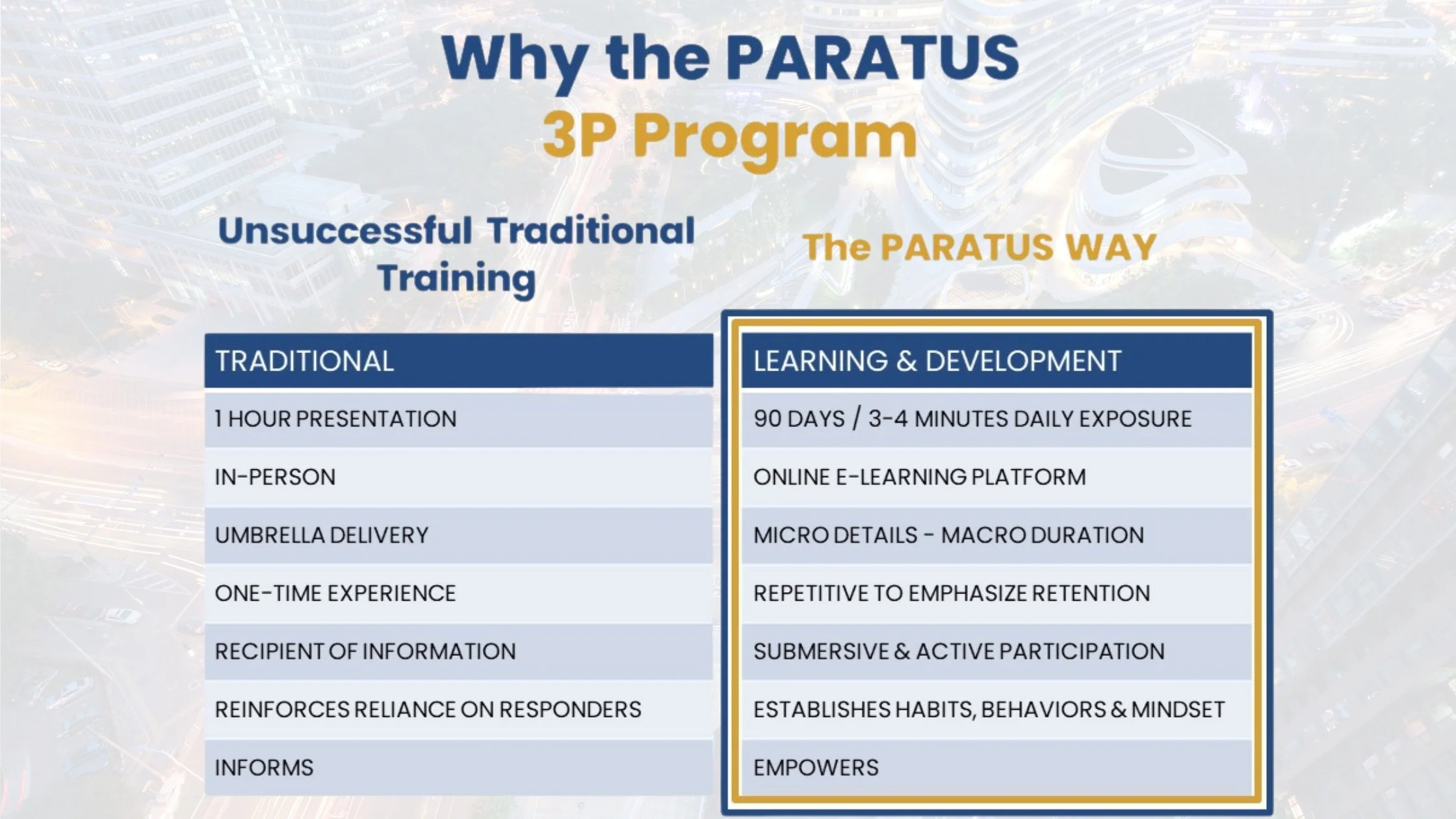
The case for breaking away from traditional training
In 2025, businesses can no longer afford to settle for traditional training methods that are reactive and generalized. To truly solve problems and ensure the safety of employees, it’s time to make a fundamental shift toward a proactive, tailored approach.
That’s where Paratus 3P comes in.
Here’s why this shift is essential for businesses:
1. Customization Drives Effectiveness
Traditional training often feels like a one-size-fits-all solution, failing to address the unique needs of different teams, roles, or industries. Paratus 3P tailors training content to fit the specific needs of each team, role, and situation. Whether it's a frontline worker or a supervisor, Paratus 3P ensures employees are equipped with the skills and knowledge that directly apply to their daily tasks and challenges. This personalized approach empowers employees to act decisively and effectively when problems arise.
2. Active Engagement = Better Retention
In traditional training, employees are often passive recipients of information, which leads to disengagement and poor retention. Paratus 3P flips this model by engaging employees in real-time decision-making and problem-solving. This interactive, hands-on approach reinforces knowledge retention and ensures employees are not just learning but also practicing and applying what they’ve learned in real-world contexts.
3. Continuous Improvement for Real-Time Solutions
Traditional training typically focuses on one-off sessions, often leaving employees to fend for themselves once the training is over. Paratus 3P, on the other hand, integrates learning into daily operations, creating a culture of continuous improvement. With layered safety briefings and after-action reviews, employees constantly learn and adapt to solve problems as they emerge. This continuous feedback loop ensures issues are addressed in real time, preventing them from escalating.
4. Proactive Problem-Solving
While traditional training may address issues after they happen, Paratus 3P ensures employees are always prepared. Through proactive strategies, teams are trained to identify and solve problems before they escalate. By instilling situational awareness at every level—group, foreman, and team lead—employees are equipped to handle unexpected challenges and mitigate risks, making them not just reactive, but prepared.
The 2025 Imperative:
As we head into 2025, businesses must move away from outdated, generic training methods and embrace a more effective, proactive approach. Paratus 3P offers the solution—creating a workforce that is not only equipped to handle known challenges but is also prepared for the unexpected. Businesses can foster a culture of safety, preparedness, and adaptability by focusing on real-time problem-solving, tailored training, and continuous learning. Now is the time to solve the problems that traditional training has left unresolved. Paratus 3P is the solution businesses need to make 2025 the year they build a truly prepared workforce.
Join the growing list of companies that are taking the safety of their team members seriously in 2025.
Contact us today.