
Beyond Locks & Cameras:
Discover how the Paratus Process (Identify, Assess, Predict) empowers you to proactively defend your home and protect your family. Learn practical strategies for boosting situational awareness, securing your home effectively, and developing habits that keep threats at bay. Take back responsibility for your family's safety today.
Home defense goes beyond locks and cameras—it's about proactive preparation. The most effective way to keep your home and family safe starts long before a potential threat reaches your doorstep. This begins with simple yet essential steps like physically securing your home and employing reliable technologies—cameras, sensors, and security systems—to create multiple layers of protection.
The Importance of Situational Awareness
Even top-notch security measures lose their effectiveness without the homeowner’s continuous practice of situational awareness. Criminals prefer easy targets—homes that appear vulnerable or unprotected. Surprisingly, many break-ins occur simply because homeowners forget to secure gates, leave doors ajar, or fail to activate security systems.
As Sheriff Mark Lamb famously stated, "Start by locking your doors." This simple habit is your first and most powerful line of defense against unwanted entry.
Your Paratus Process: Preparation is Key
True home defense requires consistently practicing the Paratus 3P Process—Prepare, Prevent, Protect.
Consider these critical questions carefully:
Will you defend your home with a weapon (such as a firearm or mace)?
Have you chosen appropriate ammunition or defense tools?
Are you prepared mentally and physically to either barricade or actively defend your home?
Do you have complete familiarity with your home's layout, inside and out?
Can you remain calm and effectively communicate during a call to emergency services?
Successful defense isn't solely about having a weapon. It involves thorough preparation and situational awareness, ensuring you can act confidently under stress.
Practice Your Process: Predict and Act
Effective home defense means understanding your home, recognizing your family's strengths and limitations, and committing to your personal preparedness. Reflect on these questions regularly:
Have all entry points—doors, windows, garages—been effectively secured?
Are you continuously practicing situational awareness to recognize potential threats early?
Do you have a clear, actionable plan if an intruder breaches your security?
Train to Defend Your Home: Take Back Responsibility
True home defense extends beyond securing locks and installing cameras—it demands proactive situational awareness and ongoing preparedness. That's why enrolling in the Take Back Responsibility Program is essential for every homeowner.
This comprehensive training empowers you to:
Recognize and predict threats before they reach your doorstep.
Develop daily habits that significantly enhance your situational awareness.
Learn proven techniques to secure all entry points effectively.
Confidently respond to emergencies with clear, practiced communication skills.
Gain the mindset, behaviors, and habits needed to keep your family safe.
Your performance in a crisis directly reflects the effort you put into preparation. By consistently practicing the Paratus Process (Prepare, Prevent, Protect), you'll develop skills far more powerful than technology alone.
Preparation Equals Protection
Ultimately, you will perform at your lowest level of preparedness. That's why the Paratus Process should be part of your everyday routine. Equip yourself and your loved ones with the skills, mindset, and habits necessary to protect your home confidently.
Empower yourself, your children, and future generations to safeguard your home and family. Preparation isn’t just a precaution—it's your strongest protection.
Ready to elevate your preparedness? Enroll in our Take Back Responsibility Program today and build your family's confidence, skills, and resilience.

Empowering Kids for Safety
Equip your children with vital situational awareness skills using practical tips and strategies from the Paratus Group. Learn how to empower your family with confidence-building techniques and safety practices to effectively handle everyday dangers.
As parents, our biggest responsibility—and our biggest worry—is the safety of our children. Equipping your kids with situational awareness skills is one of the most impactful ways to protect them. It's not about fostering fear but rather about empowering them with the tools to navigate their world confidently.
At Paratus Group, we emphasize a family-oriented approach, incorporating the proven 3P method (Prepare, Prevent, Protect) to help both parents and children develop habits, behaviors, and mindsets essential for staying safe.
Why Teach Kids Situational Awareness?
Kids naturally have less experience recognizing potential dangers. Teaching them situational awareness helps them:
Recognize and avoid potentially dangerous situations.
Build confidence and reduce anxiety.
Understand when and how to seek help effectively.
Practical Situational Awareness Tips for Families:
1. Make Observation a Game
Regularly encourage your child to point out things around them—people, landmarks, exits.
Ask simple questions: "What color shirt was that person wearing?" or "Can you spot two ways we can safely leave this building?"
2. Establish Clear Family Safety Rules
Create easy-to-remember guidelines (e.g., “We always stay close in crowded areas” or “Always check with a parent before going somewhere new”).
Regularly revisit these rules and explain their importance.
3. Role-Playing Scenarios
Practice various scenarios in a safe environment at home, such as being approached by a stranger or getting separated in public.
Discuss appropriate responses and rehearse actions clearly and calmly.
4. Empower Decision-Making
Teach your children to trust their instincts. Let them know it's always okay to speak up if they feel uncomfortable.
Reinforce that they won’t get in trouble for expressing concerns or asking for help.
5. Develop Check-in Habits
Establish simple routines for your child to check in with you regularly when out in public or visiting friends.
Use simple and discrete signals or code words for uncomfortable situations.
How Paratus Group Empowers Family Safety
Paratus Group’s training methodology is unique, providing families with accessible micro-learning content designed specifically to build and reinforce effective safety habits. Our program supports parents in teaching their children the skills of identifying, assessing, and responding effectively to threats—empowering kids to become proactive participants in their own safety.
Our ongoing support model ensures these critical safety skills remain fresh, relevant, and second nature through continuous engagement and practice.
Real-Life Impact
Families who have completed the Paratus training share stories of children confidently handling tricky situations—like knowing exactly what to do when approached by a stranger, or quickly identifying and reporting suspicious behavior at school.
Situational awareness isn’t just about avoiding danger; it’s about creating confident, empowered children who feel safe, secure, and ready to handle life’s unexpected moments.
Ready to Empower Your Family?
Join other proactive families and discover how our family-oriented training at Paratus Group can bring peace of mind and lasting security. Visit Paratus.Group to learn more and begin your journey to a safer, more empowered family.
Safety starts with awareness—make it a family priority.
Dangerous Habits and How to fix them:
Discover common bad habits distracting you from effective situational awareness. Learn practical tips from the Paratus 3P Process (Prepare, Prevent, Protect) to enhance your safety today.
We live in a world full of distractions—from buzzing phones and loud music to busy schedules and multitasking routines. Unfortunately, these everyday habits can seriously undermine our situational awareness, leaving us vulnerable in critical situations.
Today, let's spotlight some common habits that distract us and explore practical ways to overcome them using the Paratus 3P Process: Prepare, Prevent, Protect.
Habit #1: Smartphone Obsession
The Problem: Our phones demand our constant attention, and it's easy to walk or drive completely absorbed by screens, unaware of potential dangers nearby.
The Fix (Prepare):
Commit to "heads up, phones down" in public spaces.
Practice setting your phone to silent or "Do Not Disturb" when walking alone or in unfamiliar places.
Habit #2: Multitasking in Public
The Problem: Juggling tasks like carrying bags, talking on the phone, or handling children simultaneously can cause sensory overload, impairing your ability to notice threats.
The Fix (Prevent):
Plan ahead to minimize multitasking. Organize bags and tasks before leaving safe areas.
Regularly pause to scan your surroundings, maintaining awareness even when busy.
Habit #3: Wearing Headphones in Public
The Problem: Music and podcasts are great, but they isolate you audibly, making it impossible to detect nearby sounds like footsteps, cars, or alarms.
The Fix (Protect):
Limit headphone use to safe, enclosed spaces, or keep the volume low enough to hear your environment clearly.
Consider using just one earbud when in public to maintain partial auditory awareness.
Habit #4: Lack of Awareness in Familiar Places
The Problem: Comfort in familiar surroundings often leads to complacency, reducing vigilance in everyday settings.
The Fix (Prepare & Prevent):
Regularly remind yourself to observe familiar locations with fresh eyes, actively noticing changes or unusual activities.
Practice a quick mental check-in whenever you enter a familiar location to reset your situational awareness.
Habit #5: Ignoring Your Gut Feeling
The Problem: Instinct is a powerful safety tool, but many dismiss their internal warnings as paranoia or anxiety.
The Fix (Protect):
Always trust your instincts; they're your subconscious recognizing potential threats.
Act immediately if something feels off —move to a safer location or alert someone you trust.
By breaking these dangerous habits and incorporating the Paratus 3P Process, you'll transform from being vulnerable to becoming empowered, actively safeguarding yourself, your loved ones, and your community.
Ready to enhance your situational awareness?
Join our community at Paratus Group to learn more about proactive preparedness.
Enroll in the training that could save your life.
Be alert. Be aware. Be safe.
Why Situational Awareness Is Your Best Self-Defense
Discover why situational awareness is your most powerful self-defense tool. Learn proactive safety strategies, preventive techniques, and essential skills through the Paratus 3P Process. Boost your confidence, mental resilience, and personal safety—empowering yourself to protect your family and community.
Safety is something we often don't think about until we’re forced to. In our unpredictable world, threats can emerge unexpectedly, from natural disasters and public emergencies to personal safety incidents. The best defense against such threats isn't necessarily strength or speed—it's something far simpler yet profoundly impactful: situational awareness.
What Exactly Is Situational Awareness?
Situational awareness is the skill of actively observing, understanding, and assessing your surroundings at all times. It involves recognizing potential risks and threats early, giving you the critical advantage of time to avoid danger or respond decisively if necessary.
At Paratus Group, we define situational awareness as the continuous process of identifying, assessing, predicting, deciding, and acting. Through dedicated training and practice, this process becomes an instinctual habit.
Why is Situational Awareness Critical?
The essence of situational awareness lies in its preventive power. Unlike reactive measures—which are essential but secondary—situational awareness focuses on proactive prevention. As the Paratus Group emphasizes through its proven 3P Process (Prepare, Prevent, Protect), preparation helps you avoid victimization, reduces anxiety, and significantly improves your mental health and confidence in daily life.
Imagine yourself walking to your car late at night. A situationally aware individual notices potential risks—a poorly lit area, an unfamiliar individual lingering nearby—and can take immediate preventive action. This heightened sense of awareness dramatically decreases your vulnerability and enhances your overall personal safety.
Real-World Examples & Testimonials
Participants in Paratus Group’s training have shared powerful stories about how their newfound situational awareness helped them avoid potentially dangerous situations:
A mother who quickly noticed suspicious behavior at a public park and moved her children safely away, avoiding an incident.
A business executive who recognized phishing scams and cybersecurity threats, safeguarding his company from substantial data loss.
College students who successfully diffused escalating situations by being aware of their surroundings and intervening appropriately early.
These testimonials underscore the effectiveness of situational awareness training in real-world settings.
Psychological Benefits of Situational Awareness
Situational awareness doesn't just protect you physically—it also significantly benefits your mental well-being. Preparedness reduces stress and anxiety, allowing you to live confidently without constant worry. At Paratus Group, we understand that worry is not the same as preparation; the latter empowers you, transforming your outlook from fear to confidence.
How to Enhance Your Situational Awareness
Improving your situational awareness involves regular, intentional practice of the following habits:
Stay observant: Regularly scan your environment, noting anything unusual.
Trust your instincts: If something feels off, respond immediately.
Minimize distractions: Particularly in public settings, reduce focus on phones or other devices.
Take proactive steps: Move toward safer locations, communicate your plans with trusted contacts, and avoid potential threats early.
Join the Paratus Movement
At Paratus Group, we equip you with critical skills through our specialized, continuous training model. Our unique Paratus 3P Process—Prepare, Prevent, Protect—helps embed situational awareness deeply into your daily habits, behaviors, and mindset.
Empower yourself today. Become your first responder. Enroll in our training course to learn more and enhance your ability to keep yourself, your family, and your community safe.
Situational awareness isn’t just a skill—it’s your best self-defense.
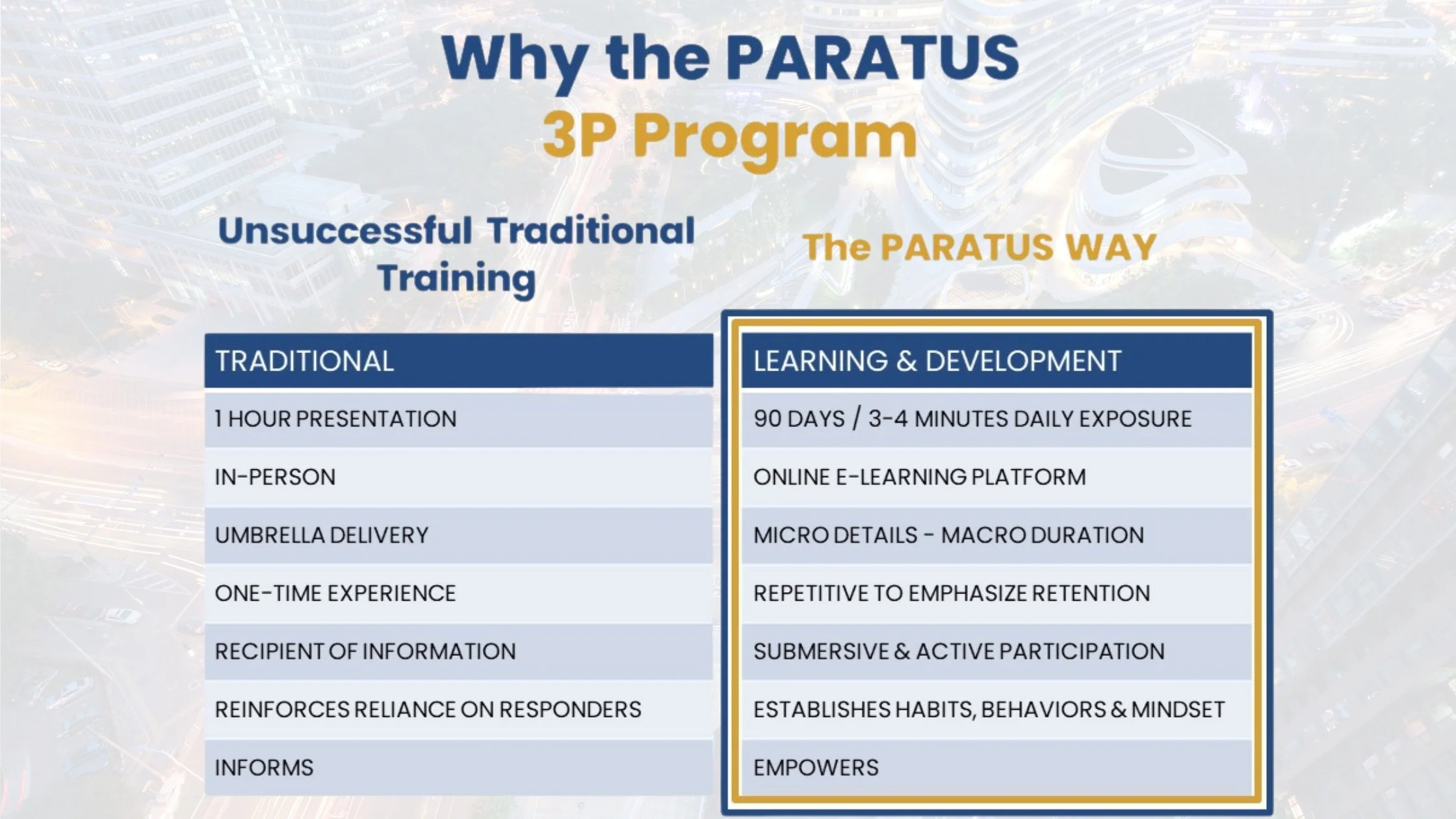
The case for breaking away from traditional training
In 2025, businesses can no longer afford to settle for traditional training methods that are reactive and generalized. To truly solve problems and ensure the safety of employees, it’s time to make a fundamental shift toward a proactive, tailored approach.
That’s where Paratus 3P comes in.
Here’s why this shift is essential for businesses:
1. Customization Drives Effectiveness
Traditional training often feels like a one-size-fits-all solution, failing to address the unique needs of different teams, roles, or industries. Paratus 3P tailors training content to fit the specific needs of each team, role, and situation. Whether it's a frontline worker or a supervisor, Paratus 3P ensures employees are equipped with the skills and knowledge that directly apply to their daily tasks and challenges. This personalized approach empowers employees to act decisively and effectively when problems arise.
2. Active Engagement = Better Retention
In traditional training, employees are often passive recipients of information, which leads to disengagement and poor retention. Paratus 3P flips this model by engaging employees in real-time decision-making and problem-solving. This interactive, hands-on approach reinforces knowledge retention and ensures employees are not just learning but also practicing and applying what they’ve learned in real-world contexts.
3. Continuous Improvement for Real-Time Solutions
Traditional training typically focuses on one-off sessions, often leaving employees to fend for themselves once the training is over. Paratus 3P, on the other hand, integrates learning into daily operations, creating a culture of continuous improvement. With layered safety briefings and after-action reviews, employees constantly learn and adapt to solve problems as they emerge. This continuous feedback loop ensures issues are addressed in real time, preventing them from escalating.
4. Proactive Problem-Solving
While traditional training may address issues after they happen, Paratus 3P ensures employees are always prepared. Through proactive strategies, teams are trained to identify and solve problems before they escalate. By instilling situational awareness at every level—group, foreman, and team lead—employees are equipped to handle unexpected challenges and mitigate risks, making them not just reactive, but prepared.
The 2025 Imperative:
As we head into 2025, businesses must move away from outdated, generic training methods and embrace a more effective, proactive approach. Paratus 3P offers the solution—creating a workforce that is not only equipped to handle known challenges but is also prepared for the unexpected. Businesses can foster a culture of safety, preparedness, and adaptability by focusing on real-time problem-solving, tailored training, and continuous learning. Now is the time to solve the problems that traditional training has left unresolved. Paratus 3P is the solution businesses need to make 2025 the year they build a truly prepared workforce.
Join the growing list of companies that are taking the safety of their team members seriously in 2025.
Contact us today.
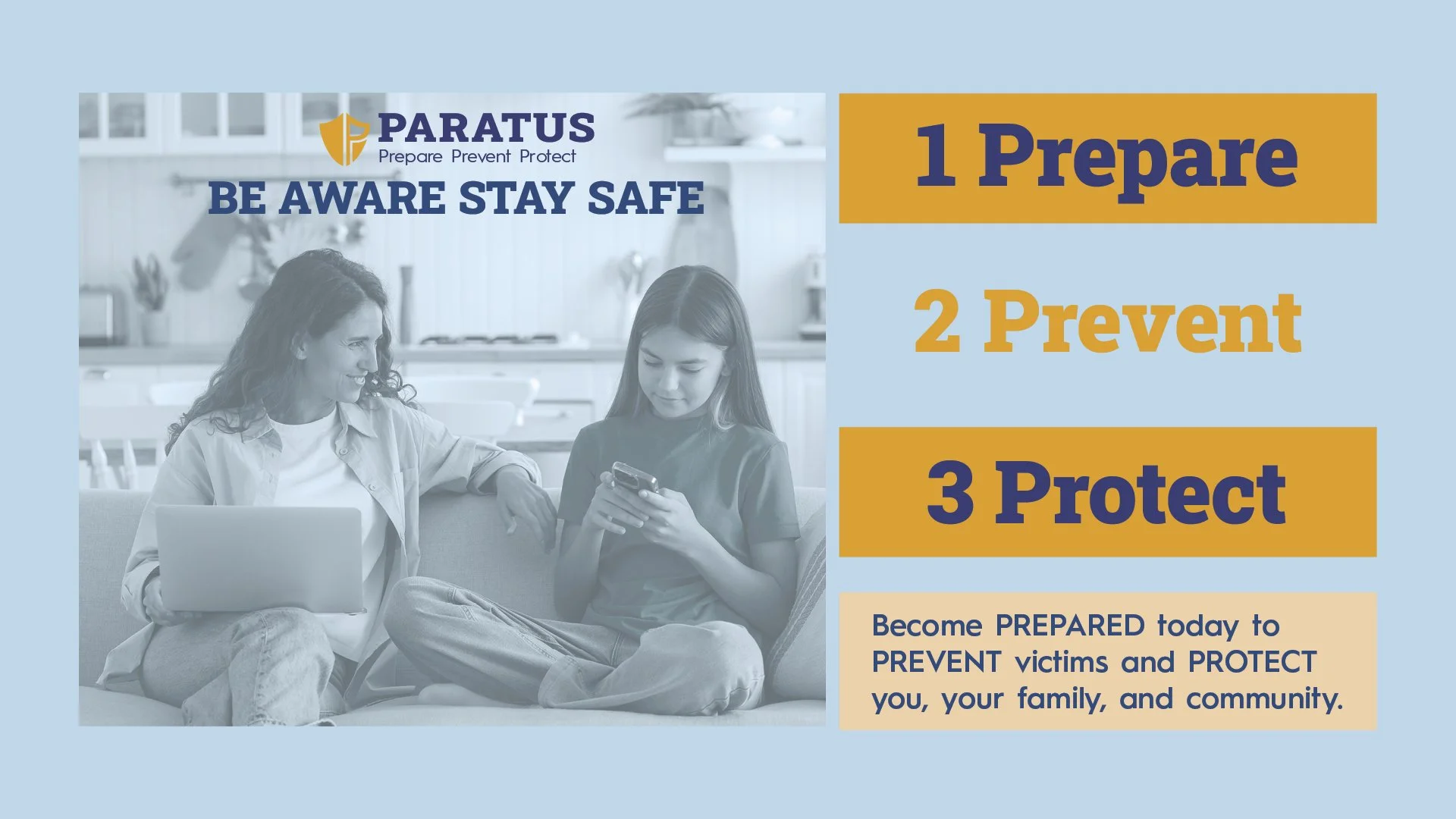
Paratus 3P Explained: Prepare, Prevent, Protect
Discover the Paratus 3P Process — Prepare, Prevent, Protect — a proven safety training method that boosts situational awareness, prevents threats, and empowers individuals with real-world preparedness and defense skills.
In today's unpredictable world, ensuring personal and community safety is more crucial than ever. The Paratus Group has developed the 3P Process: Prepare, Prevent, Protect, a comprehensive situational awareness training methodology designed to equip individuals with the skills needed to navigate and respond to potential threats effectively.
Understanding the Paratus 3P Process
The 3P Process is structured around three foundational pillars:
1. Prepare
Preparation involves cultivating situational awareness to recognize potential threats and environmental cues. Through tailored training scenarios and mental exercises, participants develop a proactive mindset that prioritizes safety in daily life. This phase emphasizes developing 10 critical skills essential for effective situational awareness.
“I have increased my situational awareness to a much higher degree. I am now considering strategies, resources, and potential threats when entering a new environment.”
— A. Beckman
2. Prevent
With preparation comes the ability to prevent incidents before they escalate. This phase focuses on de-escalation techniques, recognizing behavioral changes, and employing verbal tactics to defuse conflicts. Individuals can take proactive steps to avoid hazardous situations by understanding and anticipating potential dangers.
“Brian is extremely knowledgeable and thorough. Love how he engages with his students. Definitely an eye opener for me! I am now well aware of my surroundings after taking this course.”
— M. King
3. Protect
When prevention is not possible, the focus shifts to protection. This phase equips participants with practical skills for personal defense, escape techniques, and strategies to safeguard others during high-risk situations. The training is grounded in real-world applications, ensuring individuals are prepared to respond effectively when necessary.
“Brian is an amazing speaker. His talk on Safety and Situational Awareness has never been more timely. He's the type of speaker who engages his audience from the minute he takes the stage and leaves them ready for action!”
— J. Crilley
The Effectiveness of the 3P Process
The 3P Process offers more than just physical safety techniques; it fosters psychological readiness:
Builds Confidence: Having a structured plan alleviates fear and anxiety.
Enhances Mental Resilience: Training under stress conditions helps individuals remain composed during emergencies.
Improves Decision-Making: Practicing scenarios in advance enables swift and effective responses.
Strengthens Community Safety: Widespread training amplifies collective security and preparedness.
Real-World Impact
The Paratus Group has successfully trained diverse groups, including educators, corporate teams, and community leaders. Participants consistently report heightened awareness, improved confidence, and a greater sense of security in their environments.
Empower Yourself with Preparedness
Safety is not a matter of chance; it results from deliberate preparation and proactive behavior. The 3P Process: Prepare, Prevent, Protect is designed for everyone, providing the tools and knowledge necessary to navigate the complexities of today's world confidently.
Take the first step towards enhanced personal and community safety.
👉 Explore our situational awareness programs and experience the transformative impact of the 3P Process firsthand.
With Paratus Group, you're not just reacting to the world—you’re prepared for it.
For more information and to read additional testimonials, visit Paratus Group official website.